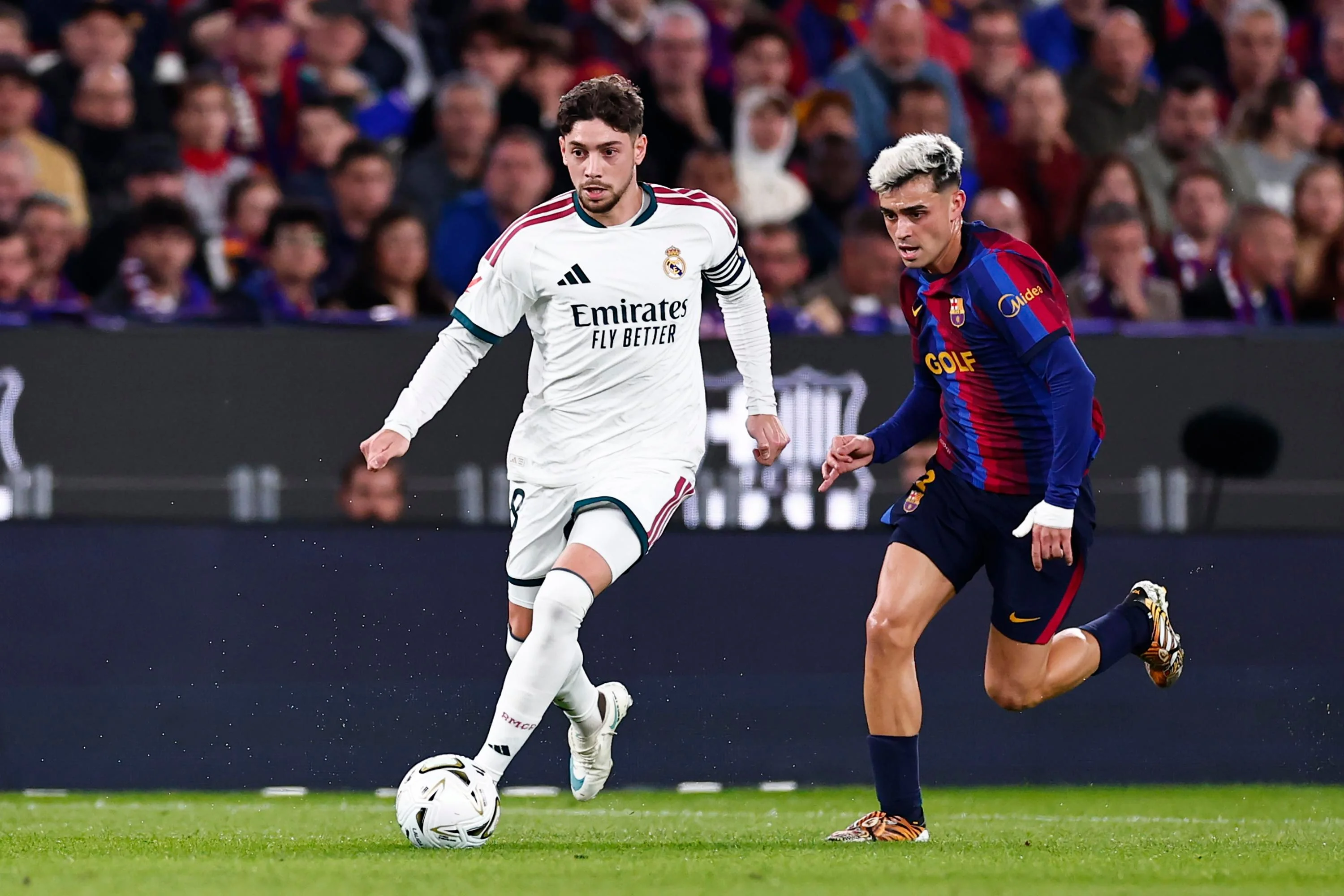
Real Madrid’s route through Barcelona’s press was built around a repeatable problem: draw the Catalans toward one side, then attack the space their shift leaves behind. In the El Clásico described here, José Mourinho’s team used Federico Valverde’s passing range, coordinated wide combinations and late runs to turn Barcelona’s pressing structure into openings. The pattern echoed what Paris Saint-Germain had shown at Parc des Princes: once Barcelona’s players were pulled out of position, a quick switch could expose the far flank.
The opening comes from Barcelona’s shift
The key was not simply to play long. Real Madrid needed to create the time and angle for a switch by first encouraging Barcelona to compress around the ball. That meant using the width of the pitch deliberately, while keeping players positioned to exploit the opposite side as soon as the defense moved.
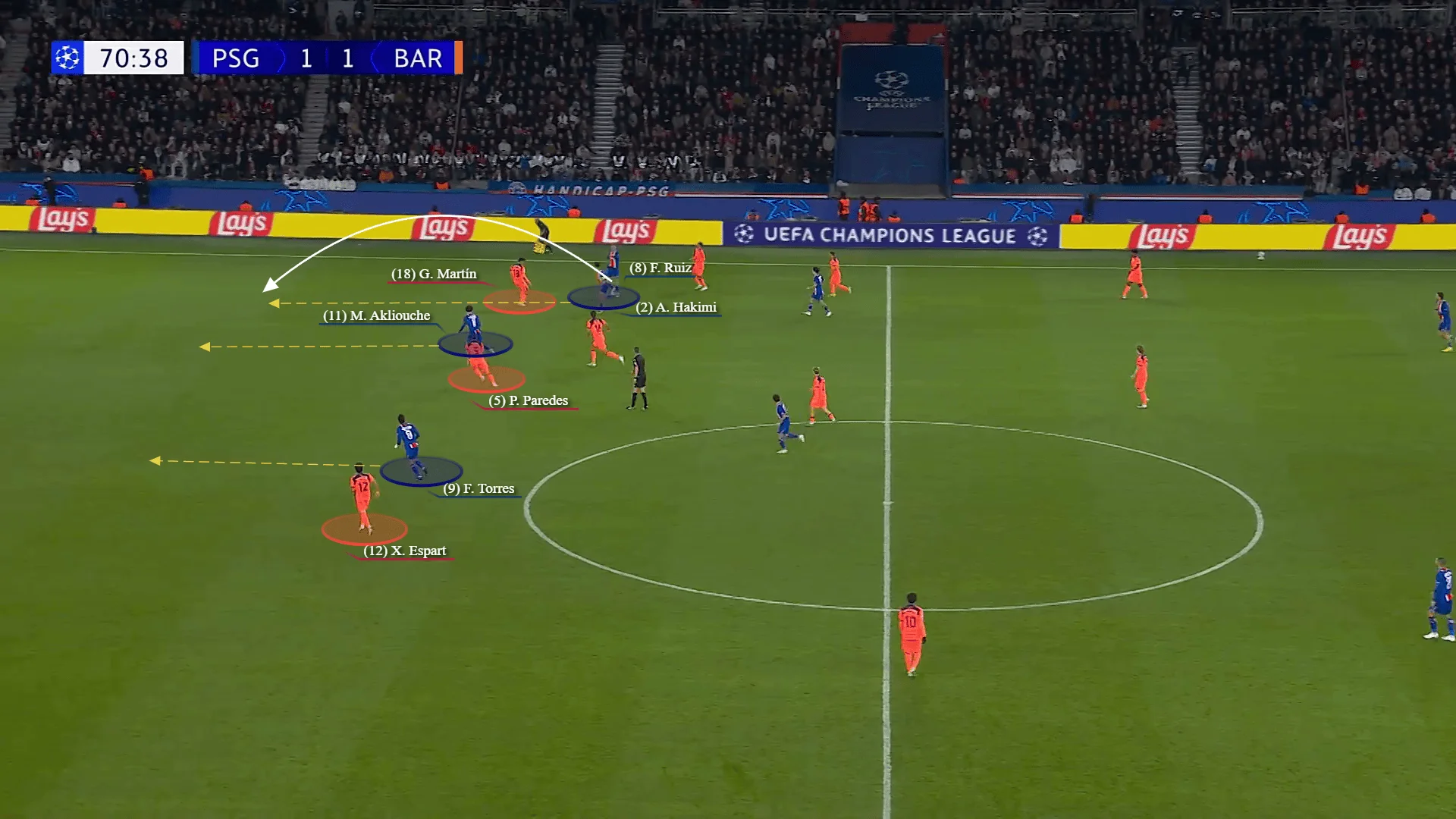
At Parc des Princes, Barcelona had faced a similar sequence after losing possession in the attacking third. The team tried to direct Paris Saint-Germain toward the flanks, but PSG used a third-player combination to find Lucas Hernandez in space on the left. Lamine Yamal’s position left him some distance from Hernandez, and Xavi Espart had to abandon Khvicha Kvaratskhelia to close down the ball carrier diagonally.
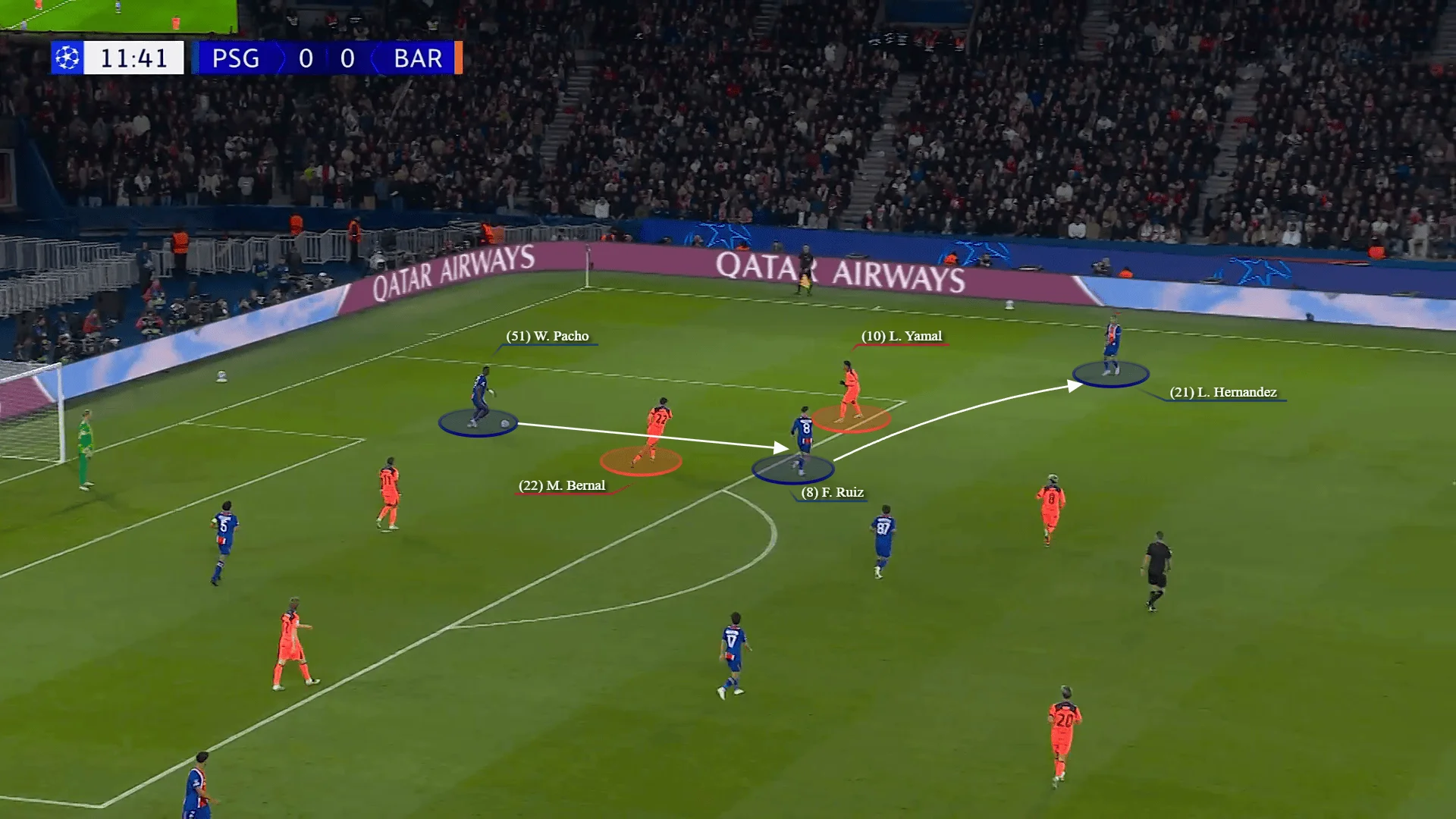
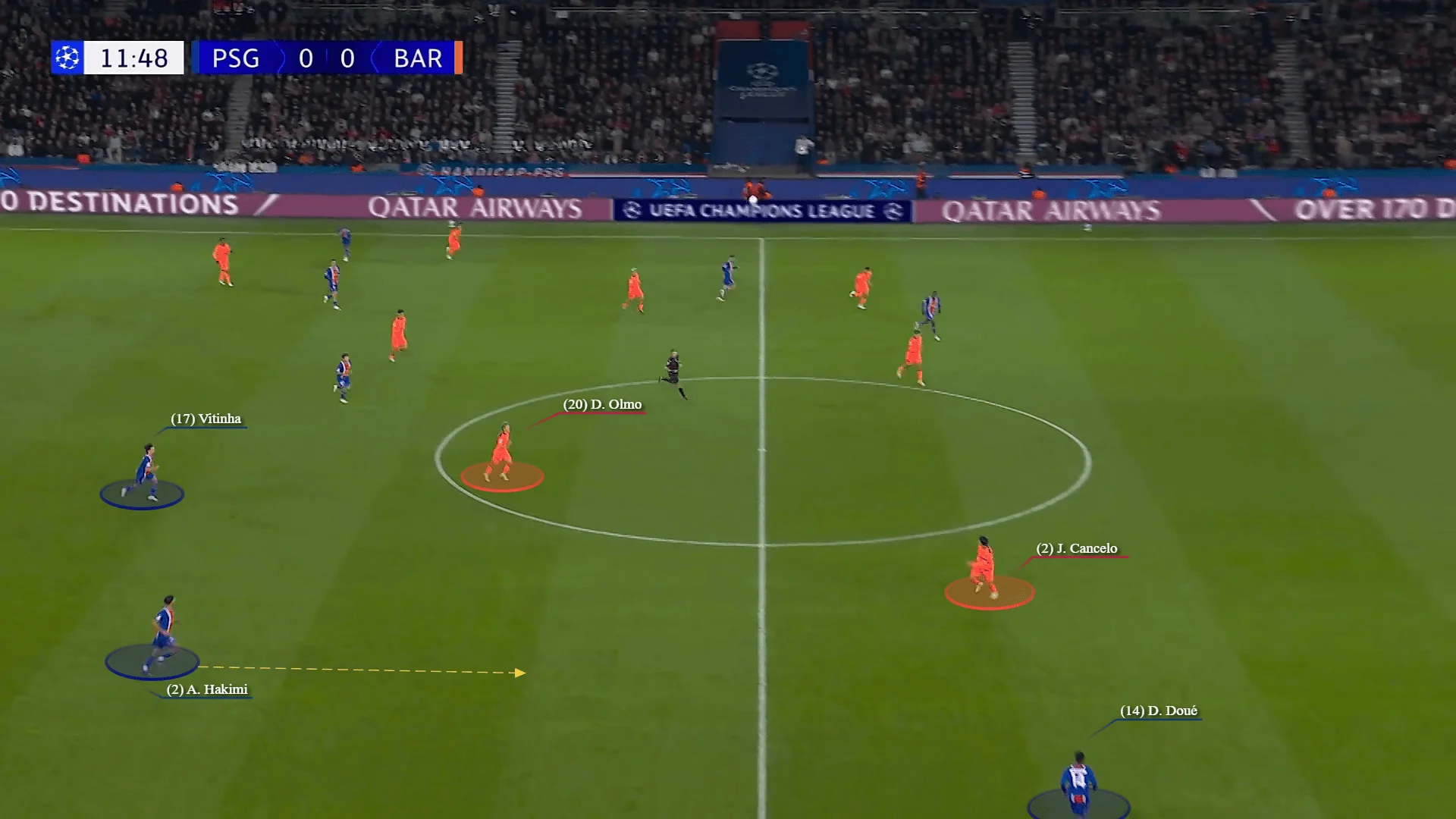
That movement stretched Barcelona’s back line. With the fullbacks separated, the rest of the defense had to slide toward the ball. Hernandez could take time to look up and send possession across the pitch, where Achraf Hakimi, Vitinha and Désiré Doué had an overload against João Cancelo and Dani Olmo.
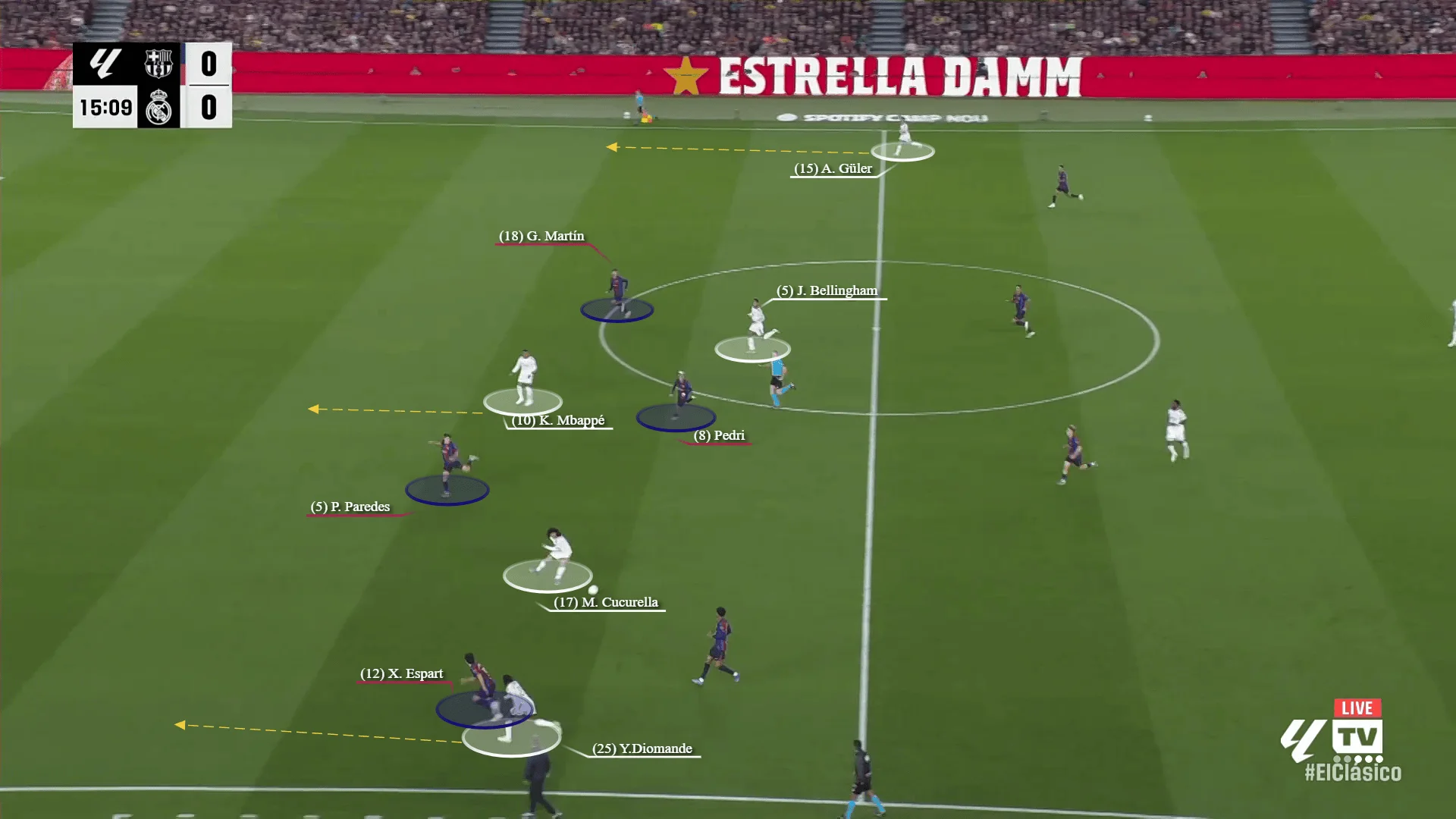
Real Madrid found a comparable opening around the 15th minute. Valverde’s deep starting position increased the distance between him and Cancelo, giving the Uruguayan room to play across the field. As Madrid worked the ball to its right, Yamal moved inside toward Dean Huijsen. That left Marc Cucurella space to advance into the left half-space and receive a switch behind Yamal.
The next movements exposed the cost of Barcelona’s shift. Yan Diomandé’s position near the flank drew Espart across, while Cucurella stayed free because Yamal did not track his run. Pedri had too much ground to cover between the two half-spaces to arrive in time. Diomandé’s pass landed behind Cucurella’s path, but the underlying gaps were already there: Diomandé was running beyond Espart, Kylian Mbappé was positioned to threaten behind the line, and a switch toward Arda Güler remained available.
Valverde turns width into a weapon
Thibaut Courtois missed the match with flu, leaving Andriy Lunin in goal. Lunin offered Madrid reliable shot-stopping and, in the account of the match, added value during build-up. One diagonal pass illustrated the team’s wider approach: it dropped behind Cancelo toward Güler’s preferred foot, allowing him to lay the ball off to Valverde with his first touch. Madrid had an extra player wide on both sides.
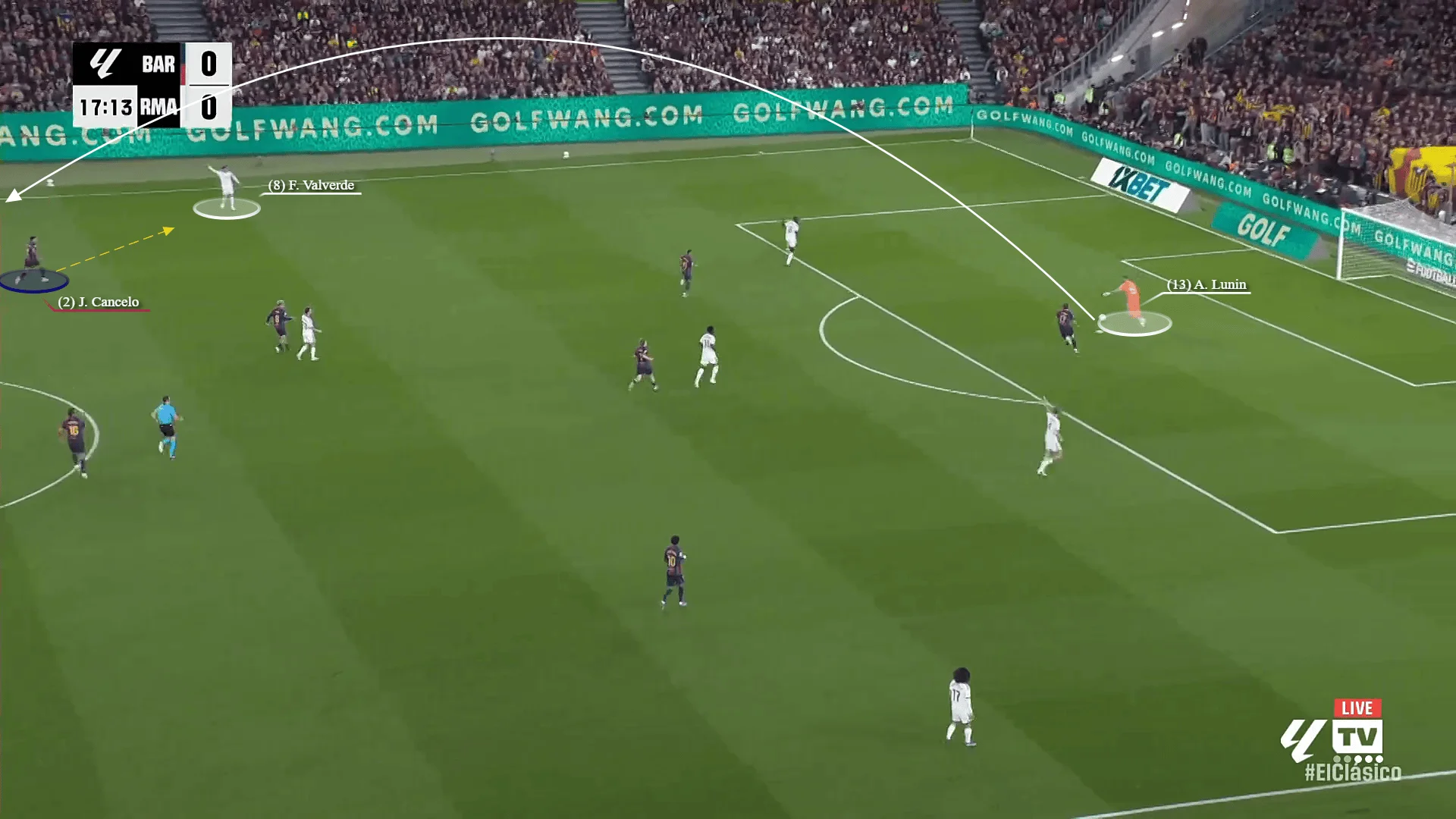
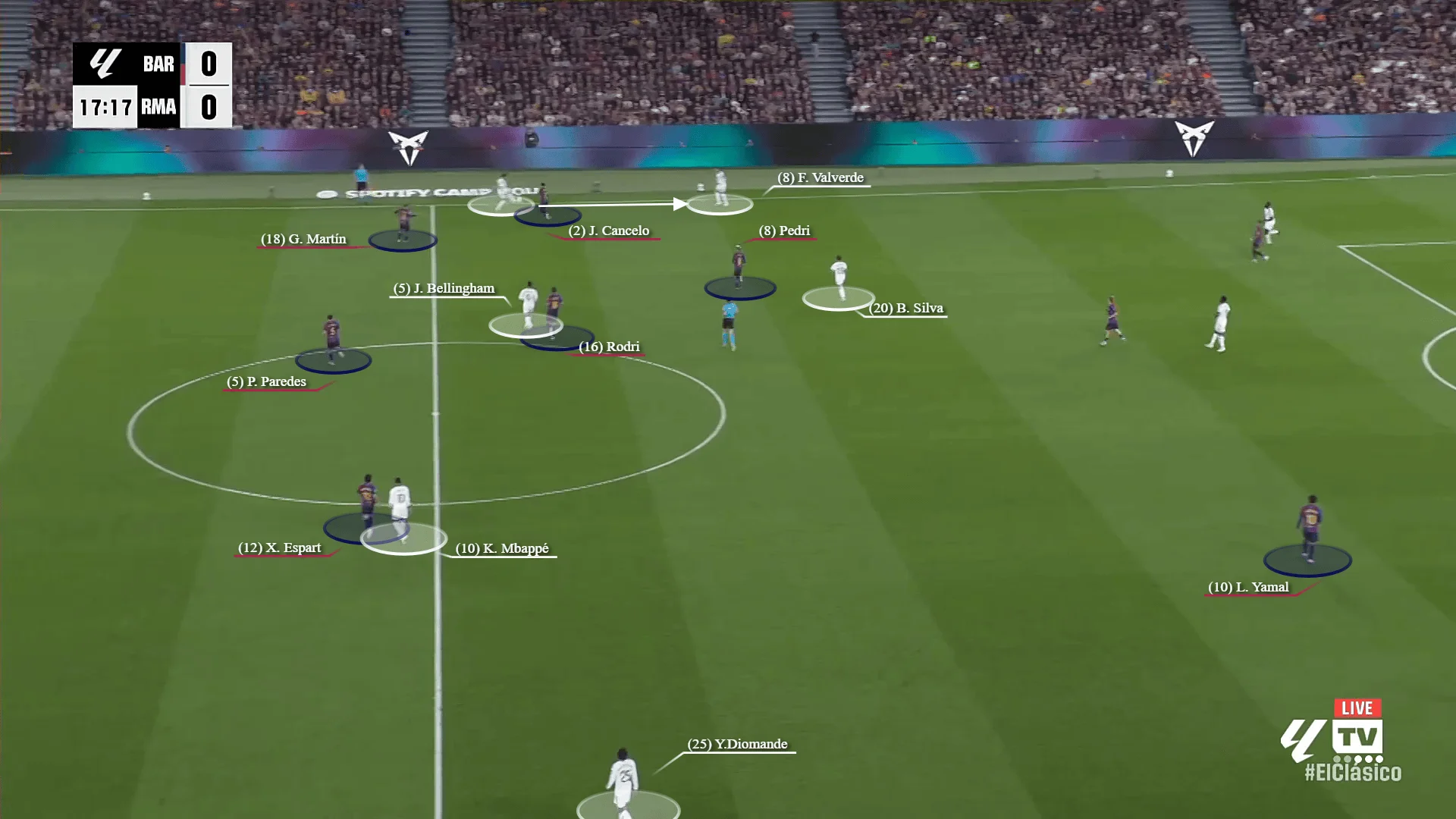
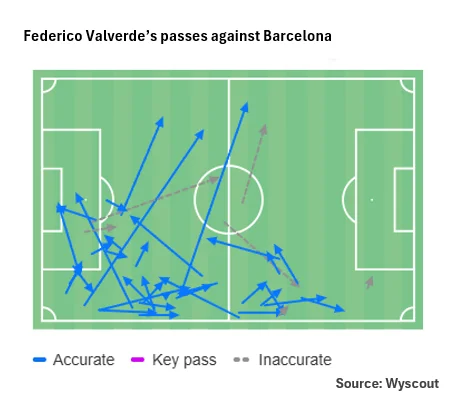
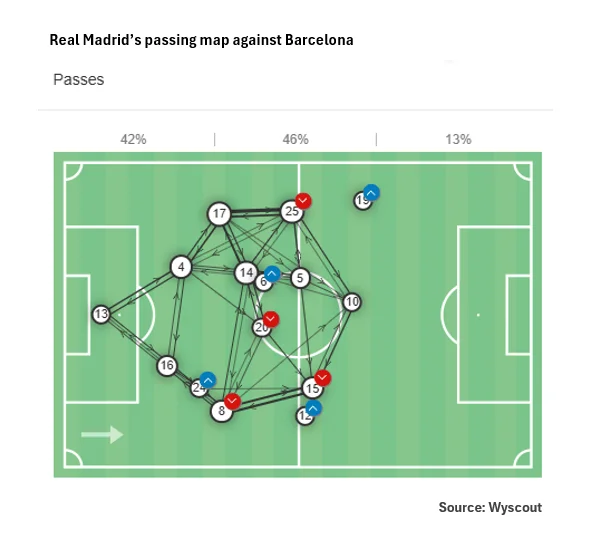
The intention was to pull Barcelona toward the ball side and give Valverde a clean view of the far flank. His passing map reflected that plan. When he switched play, Mbappé, Diomandé and Cucurella were positioned to outnumber Espart on the left.
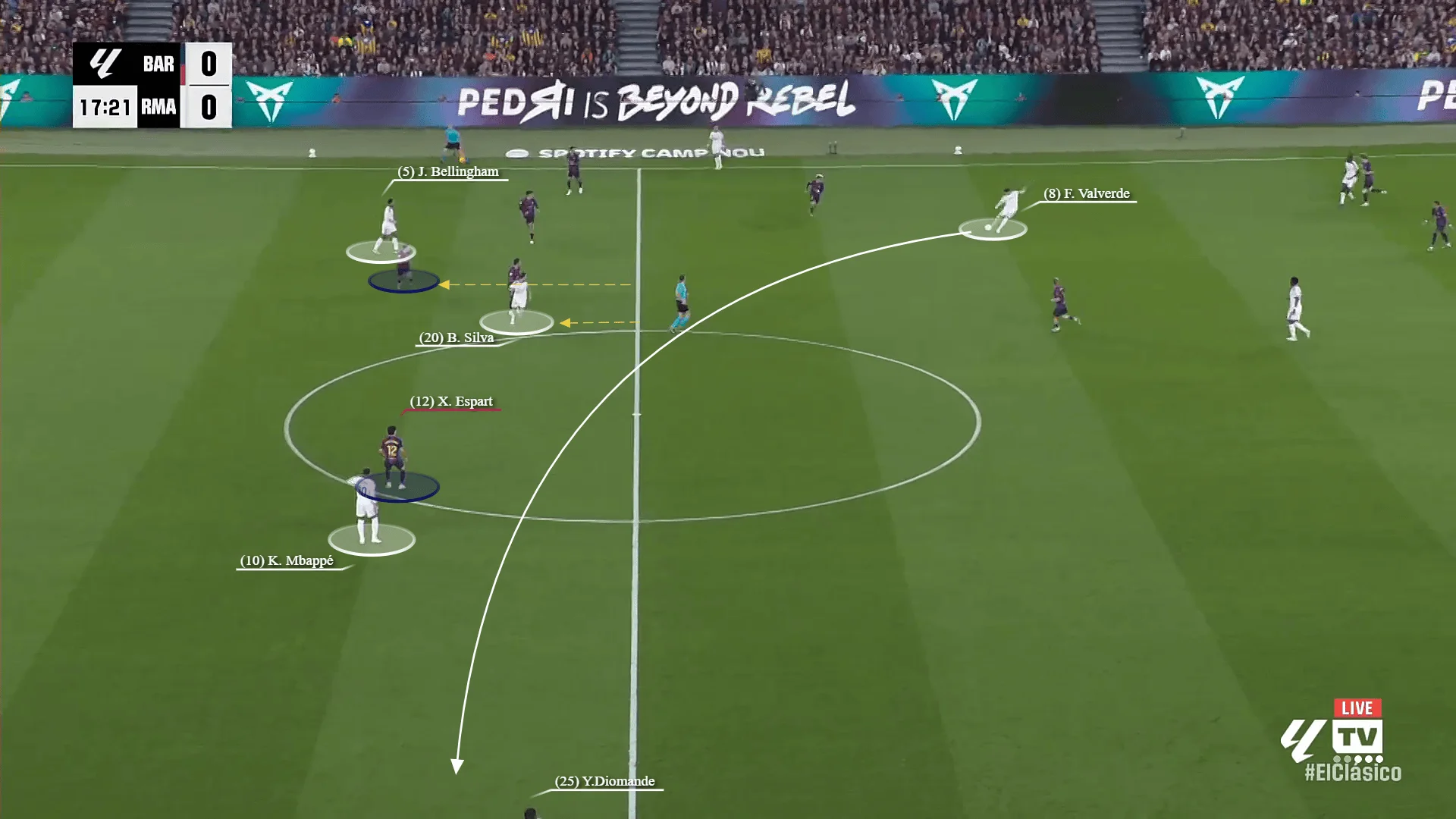
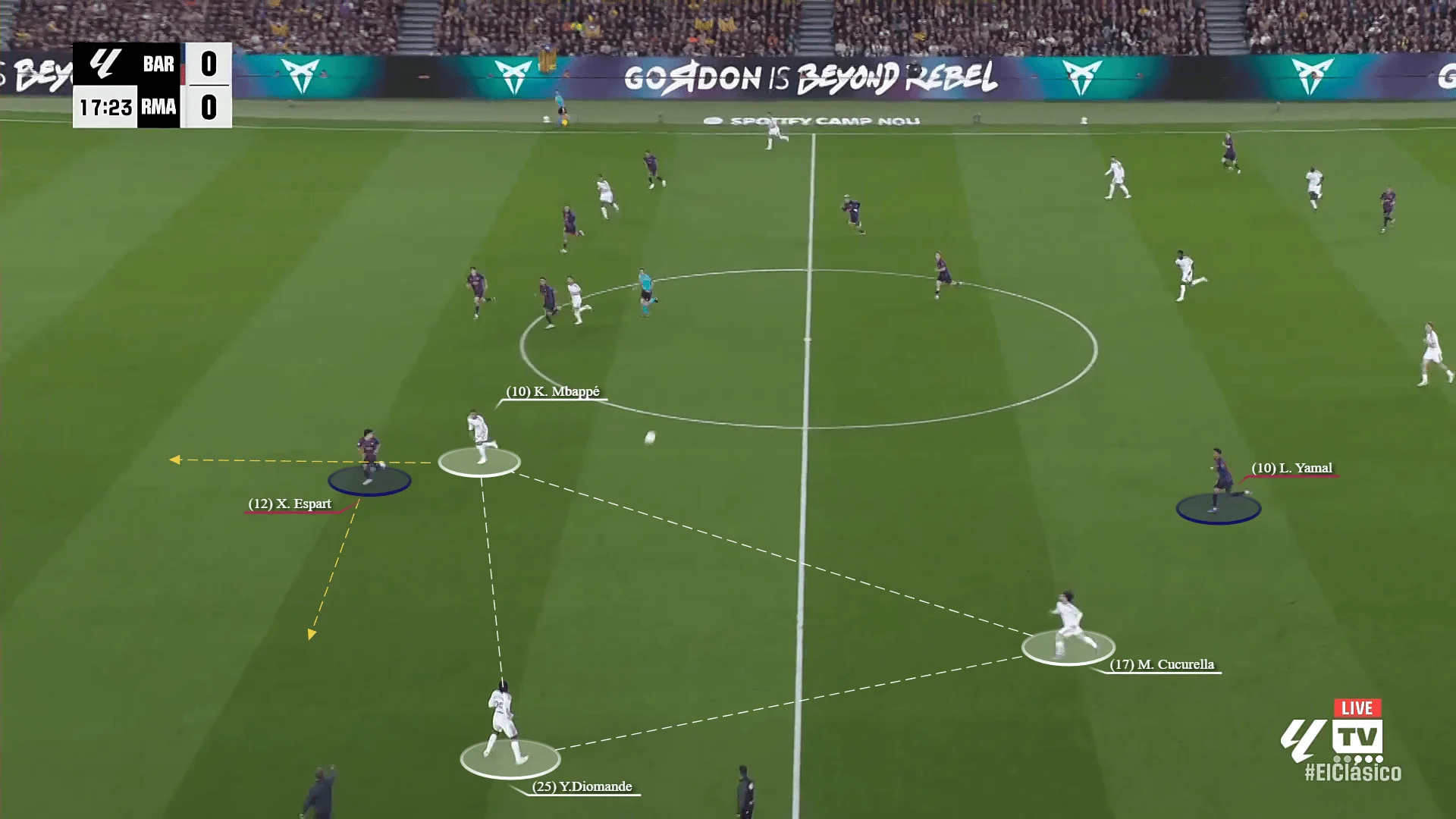
Mbappé then attacked the gap between Espart and Pau Cubarsí. Barcelona closed him down near the six-yard box, but Madrid recycled the ball through Aurélien Tchouaméni. His pass found Güler around the penalty area, ready to shoot. The sequence shows why the switch mattered: it moved Barcelona’s defense, created a numerical advantage and left Madrid able to continue the attack after the initial opening was blocked.
Around the 40th minute, Barcelona had to move from a medium block into a high press, and the same structural issue resurfaced. The distance between the fullbacks on the ball side made it difficult to pressure the carrier quickly. Pedri and Rodri shifted across but stayed in zonal positions, allowing Madrid to work possession out with short diagonal passes behind Raphinha and Anthony Gordon.
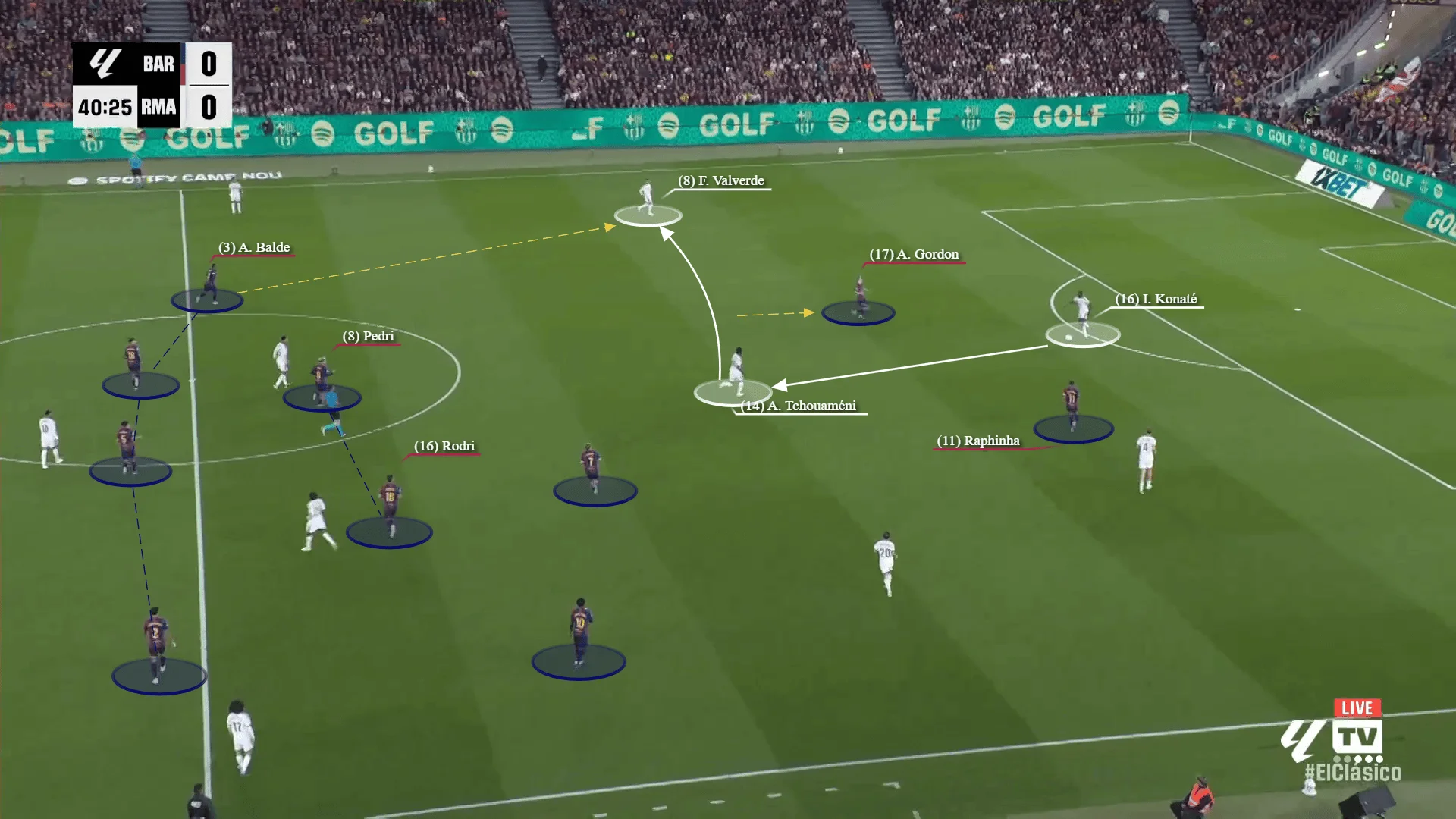
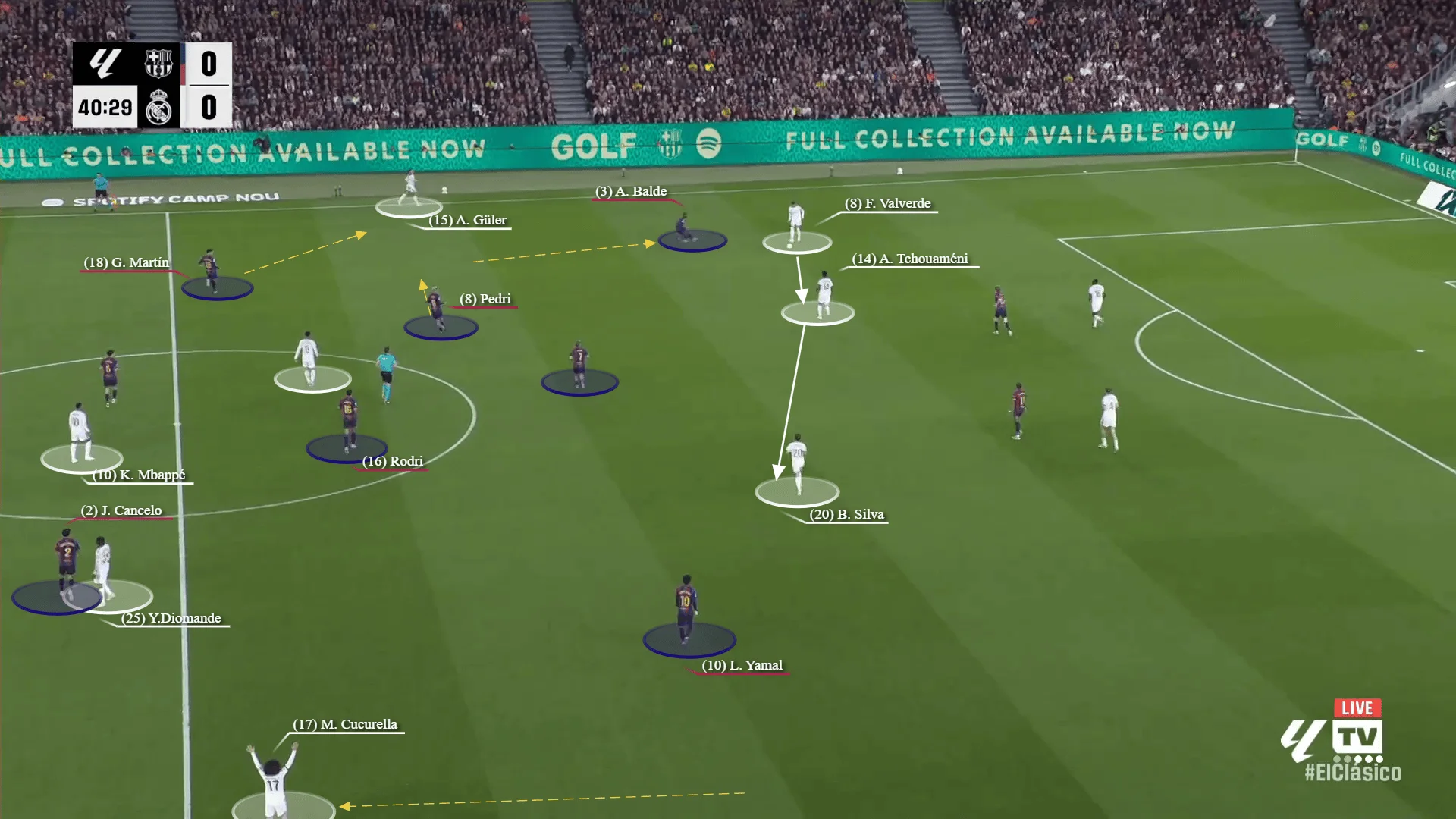
Cucurella again advanced without immediate pressure and held the touchline, while Diomandé ran into the channel between Cancelo and Cubarsí. Cucurella released him into the box, where he could look for teammates arriving from behind. Gerard Martín’s clearance struck Mbappé and went in. The goal followed a sequence Madrid had been trying to create: draw Barcelona across, find the free wide player, then attack the space around the retreating back line.
Wide combinations and runs behind
The switch was only one part of the answer. Barcelona’s high press and the close spacing between its back line and double pivot often directed opponents toward the wide channels. To escape there, a team needed coordinated movement among the fullback, central midfielder and winger. Madrid’s passing connections linked Valverde with Güler on the right and Cucurella with Diomandé on the left.
One wide combination began when Gordon stepped toward Ibrahima Konaté. Valverde and Bernardo Silva exchanged positions, prompting Pedri to follow Valverde. Pedri gestured toward Silva, who had not been closed down, but Cancelo could not step out because Güler was occupying him. Pedri therefore had to move wide, while Rodri stayed with Jude Bellingham. Valverde and Silva had created a two-against-one against Pedri in the channel.
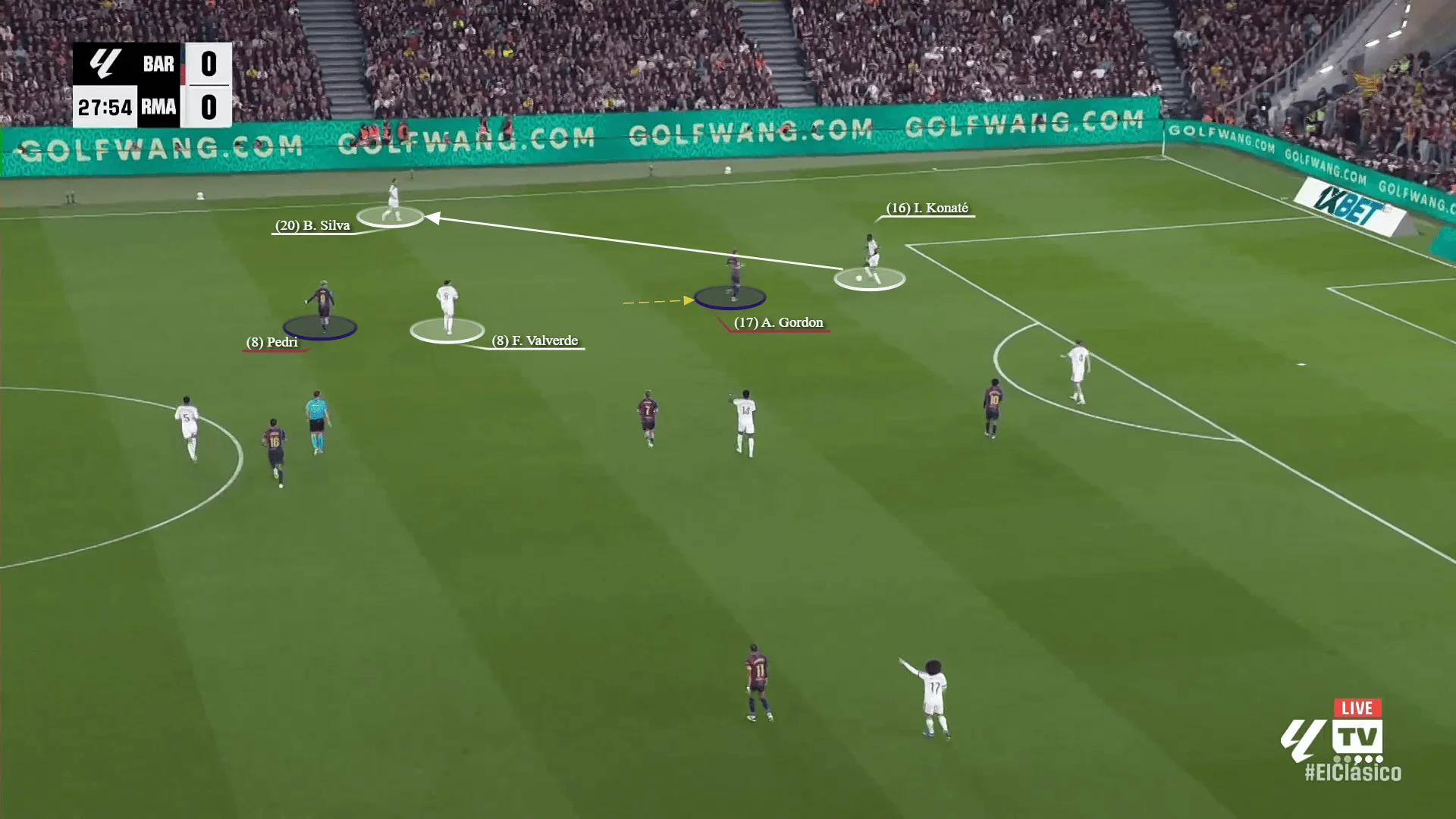
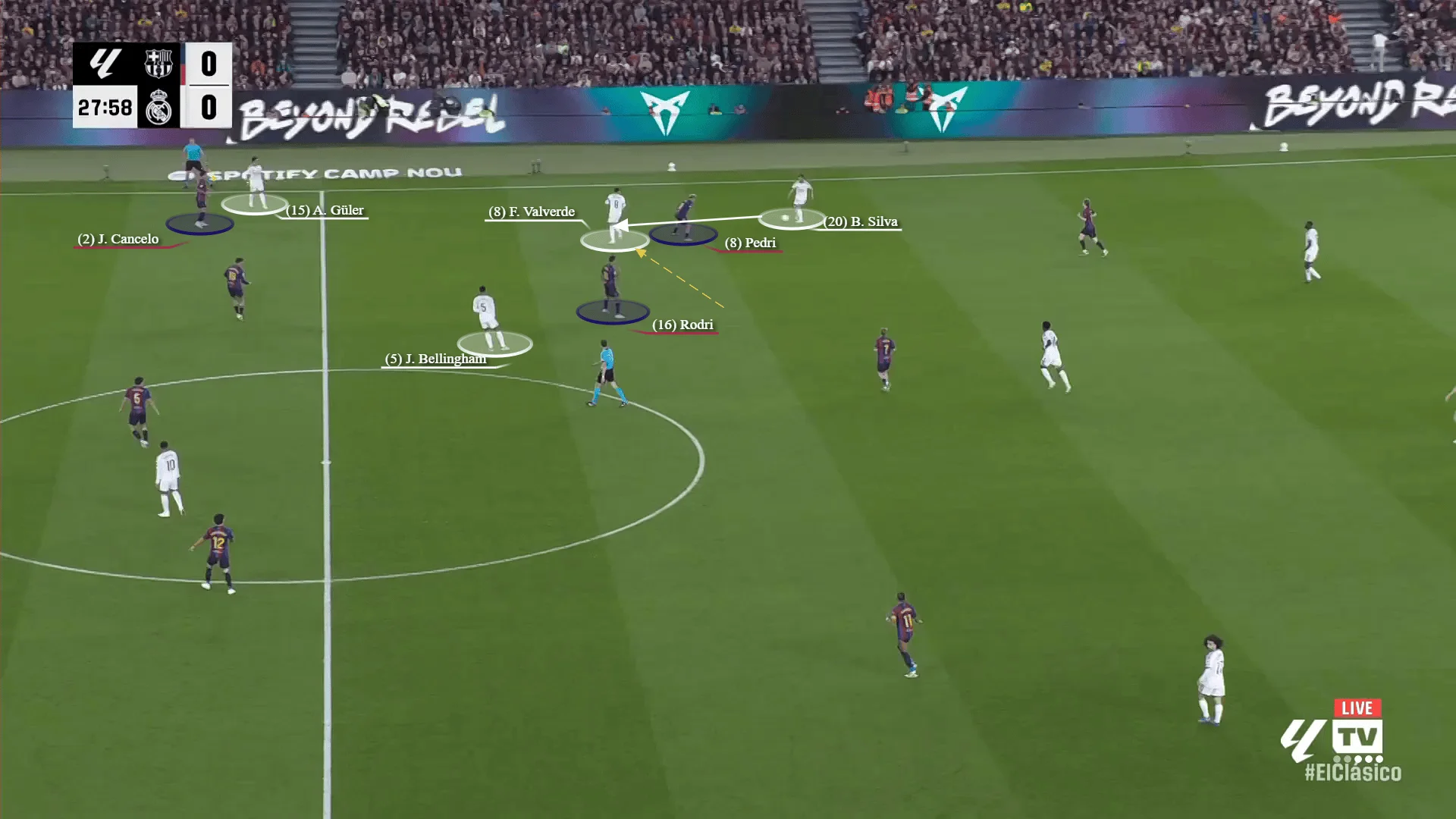
Valverde found Güler, who drove between Martín and Cancelo. Güler released him into space to send the ball back toward late arrivals, but Martín blocked the pass. The move still illustrated the value of the rotations: Madrid could force Barcelona to choose which runner to track, then attack the space created by that choice.
Late runs offered another way to challenge Barcelona’s high line. PSG used Hakimi’s delayed movement between the center-backs after drawing Barcelona toward the flank. A pivot shifted across to cover behind the fullback, helping PSG create a midfield overload and work the ball wide. Hakimi’s timing then allowed him to run beyond the defense without triggering the offside trap too early.
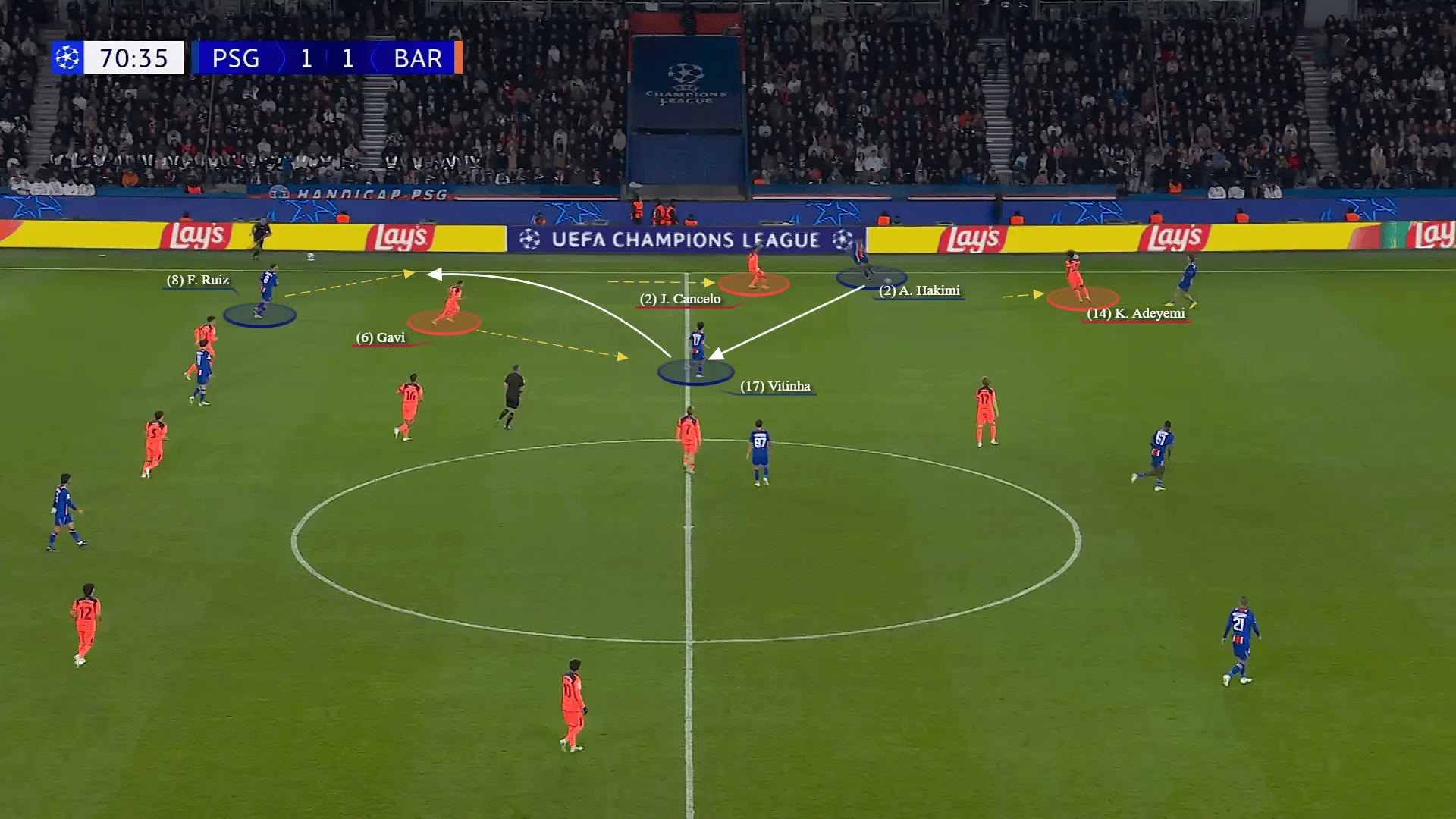
The fullback’s advance prompted a pivot to slide across and protect the space behind.
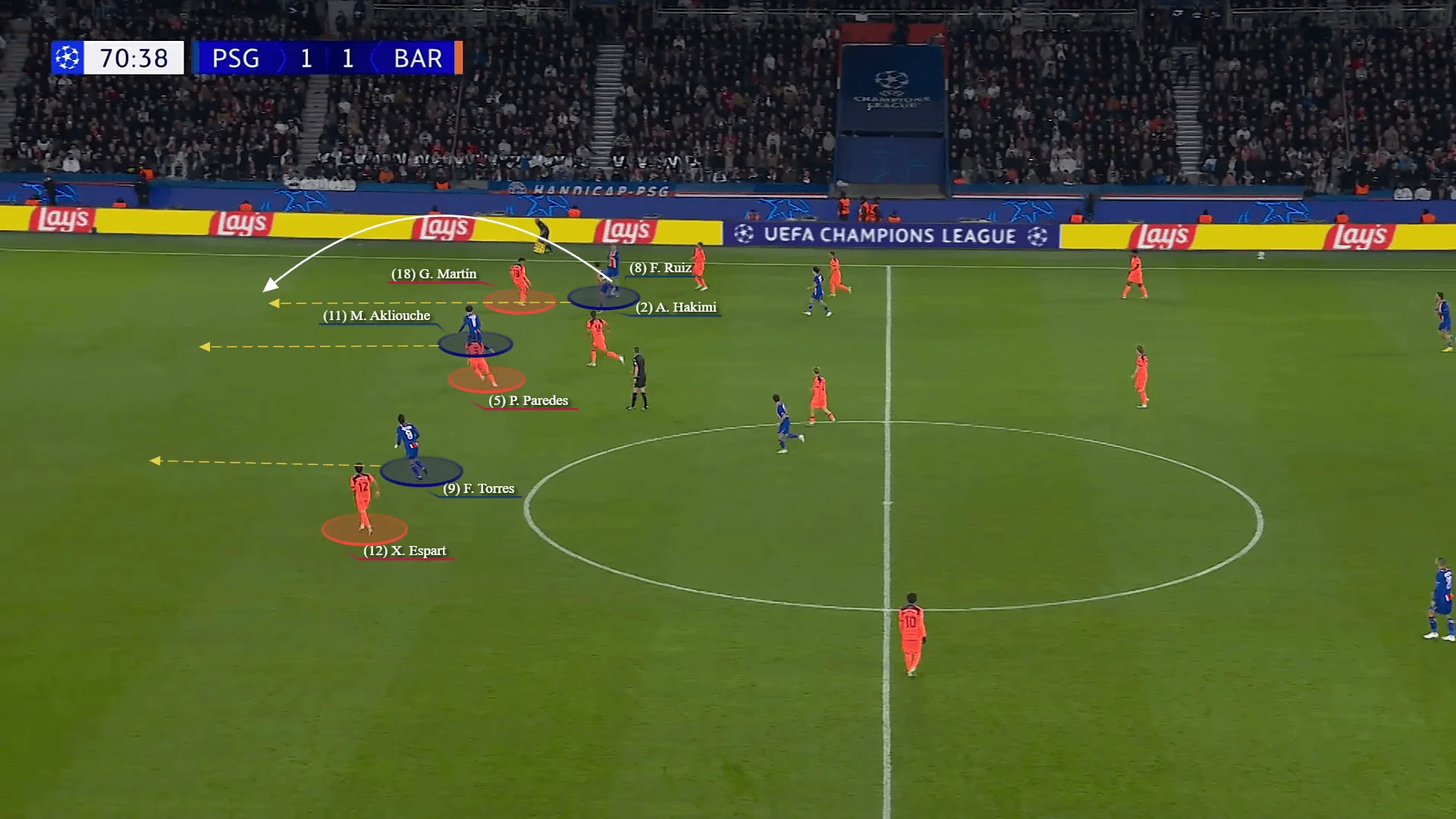
That shift helped PSG move the ball toward the flanks before Hakimi made his run between the center-backs.
Madrid’s late attack drew on the same principle. With three minutes remaining before injury time, Bellingham recovered the loose ball and evaded the pressure of Pedri, Jesús and Alejandro Balde, finding Eduardo Camavinga ahead of him. Camavinga attacked the space behind with a delayed run. Güler supplied the pass before the assist, and Camavinga slipped the ball around Cubarsí before cutting it back for Mbappé to finish.
The tactical contrast with Madrid’s match against Leipzig is revealing. That performance showed the team’s ability to dominate; El Clásico showed it could also defend compactly against a similarly strong opponent while retaining several ways to progress the ball. Mourinho’s side had answers across the pitch: switches when Barcelona shifted too far, combinations when the wide trap engaged, and late runs when the high line offered space behind. The next test is whether Madrid can keep those options connected as the team develops.